Wednesday, 16 July 2025

Santa Rosalia

I saw a recumbent elephant in the mountain across from where we are staying.  Giuseppe, who has lived here for over 70 years has always seen a recumbent girl, with her back turned to us, and hair flowing out (as opposed to trunk of elephant.)  Far more romantic.  

The pageant passing through Quatro Canti, Palermo
Credit drintle.com

Rosalia was of Royal Norman decent.  She did the counter-cultural thing by eschew privilege and opting instead to live as a hermit in a cave in the Pellegrino hills above Palermo.  And that would have been that.  For hundreds of year she was remembered and revered.  Then in the midst of a seventeenth century plague, a woman found human remains in a cave.  She brought them back down into the city, and miraculously the plague departed.  The bones are now in the Cathedral, and Santa Agata had to become second saint of Palermo, because Santa Rosalia had saved the city.   

On Monday we joined the citizens of Palermo outside the cathedral.  We were told to get there by 6:30.  Nothing happened until 9:30, except the action going on about us all the time.  The crowds built up steadily.  We were reassured that we hadn't missed the nod about the correct start time.  Perhaps it's like the airport, with the opportunity for an enhanced duty free experience.  The information on the internet was very vague.  The many posters splashed across the city published by the church didn't even mention Monday.  They were more interested in Tuesday.  Monday is the 'pre-festival'.   This is largely secular, and supposed to be riotous.  Halloween is better known that All Saints day in a similar way.  The church is worried that the populous will become tired and drunken, unable to get up for church, especially as it is a local bank holiday. 

For three hours we watched the hawkers trying to get every women, and then the men, to buy rose headbands.  We saw the uniformed police, carabinieri, firemen, football teams (Rosalia FC), Croce Rosa and marshals doing their thing.  There were men dressed in ancient military uniforms.  They mingled and marched and looked splendid and important.

The VIPs assembled in the balconies overlooking the street.  From time to time the sound system blared out a girl's voice, calling to us to stay strong, and survive.  The saint was still at work.

At last the distant floats we could seen by the Porta Nuova started to inch forward, and all the uniformed officers jumped into action.  They had to clear the way of people in a hurry to avoid another calamity for the city. But where can a street full of people be move to?  We were tactically positioned behind a barrier, next to a lamp post which offered some protection, and near to a marshal (surely the last people who are going to be crushed.)   With the skill only Italians possess, the street was cleared onto the pavement, and we found ourselves pressed all about with hot bodies.  everyone was very kind and patient.  Three very old ladies, one of whom could speak English having lived in London some time ago. were there to help and protect us.  They kept us informed about the goings on, and one showed us the local TV station on her phone, who were covering the event.  The presence of the saint could be felt.

Our new friends explained that Tuesday was the real event.  Tomorrow was when the sacred relict would be taken out and processed.  Indeed the Cathedral had it's own set of decorations and lights that were not in use on Secular Monday.  Tomorrow there would be choirs, bands, pointy hats and the effigy of Rosalia and her reliquary, to be held aloft and carried with mesmeric swaying down a different route. We were leaving Palermo so unfortunately we were to miss the serious bit.  

But tonight things were just hotting up.  As the floats passed us, with booming music, a light show was projected onto the cathedral.  By now we had been squeezed away from our prime position by the general mass of people and were around the corner from the cathedral  Fortunately all could seen vicariously via the numerous images of the event on people's phones held aloft.  Periscopes everywhere, enabling us to see round corners. 

And there was young and beautiful Rosalia, comforting her people.  The people cheered.  Then the Bishop came out and sneaked in a very long sermon (well it was in Sicilian.) We could guess the contents.  Praises be to Rosalia. 

We nipped to our flat across the filled-in river, and then joined the mass of young people heading for the sea.  We arrived to the sound of 'Land of Hope and Glory' as the firework display began.  Following a stream of people we ascended the stairs onto a Doric colonnaded gazebo, and saw stars between the pillars.   The tremendous show was slightly obscured, but the atmosphere was tremendous, with people about us dancing the the thunderous music and explosions. I was reminded how we have always opted for pillars at Stratford, and always appreciated a great show.

The Logia on the Foro Italico (taken in 1914) sea front
in Palermo where we saw the fireworks. The gardens now stretch
 a further 50 meters into the sea.  After the second world war, the
rubble from the ruins was dumped into the sea and then
 eventually landscaped into gardens.
Credit Wikipedia. 


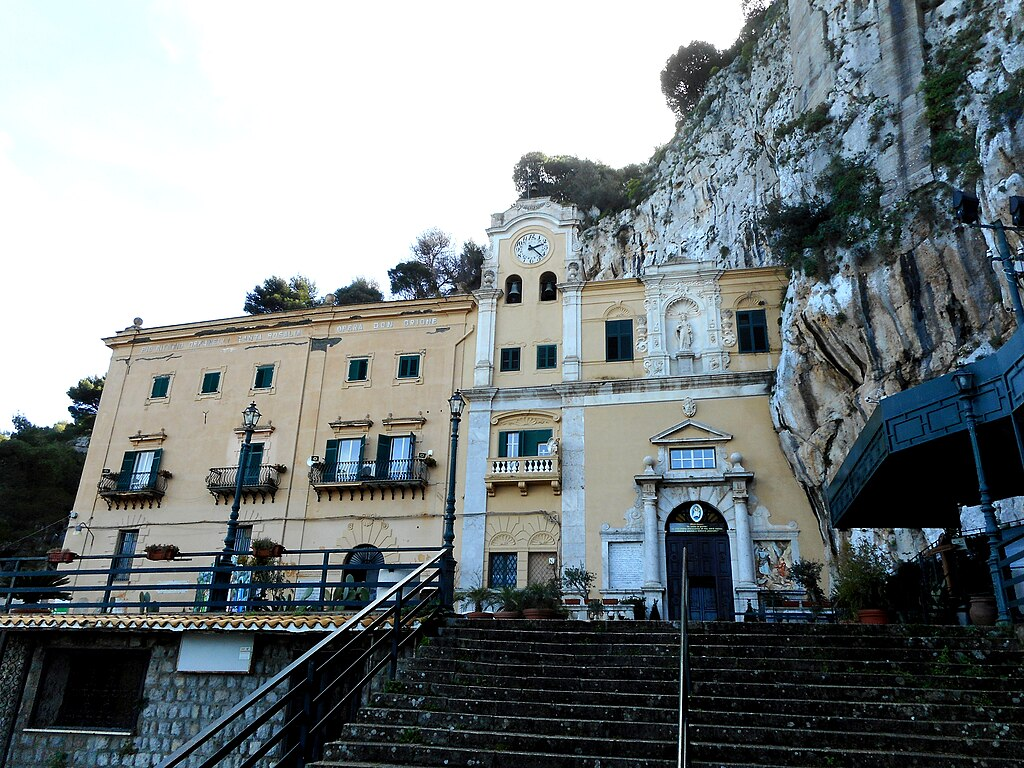
The Grotto of Santa Rosalia
Credit: Wikipedia, Stendhal55


Monday, 14 July 2025

I Mille (The Thousand)

Ancient map of Parlemo. 
Palazzo Conte Federico occupied the tower
of the old Arab wall nearest the bridge to the 
left. The bridge no longer exists as the whole
harbour has been reclaimed.
Credit researchgate.com
Giuseppe Garibaldi (born in 1807 in Nice, speaking Ligurian- a form of Italian) was 53 when he became the 'dictator' of Sicily for about 6 months.  He had managed to sneak into Sicily with his 1000 men (or as reported in 'The Leopard', was it 800?)  He cleverly used the British navy in Marsala as cover.  The British were protecting the trade in Marsala wine at the time, which was extremely popular and lucrative back home. 

Frederic II, the Bourbon King of Naples (the Two Sicilies) fancied the infiltration to be a mild inconvenience.  

Sicily has been in constant political flux, and the idea of a united Italy might have been developing in the multiple personalities of Italy.  Frederic, the Conte de Frederic's son, told us on his guided tour of their Palazzo, that it was the Masons, and 'the great powers' including Britain, who wanted Italy to be a united nation, and a bulwark against the expansionists designs of Russia.  This is counter to my assumption that the Italian's themselves saw that unity might be necessary at this time to protect them from nearer neighbours.  Already ruled by the Greeks, Romans, Arabs, Normans, Visigoths, Swabians, the Spanish, French, etc, the Sicilians knew that another spin of the dice was bound to occur. "In order to stay the same, everything must change" - the famous quote from 'The Leopard', or Il Gattapardo, by Giuseppe Tomasi de Lampedusa.  'Gattapardo' is the symbol of the house of Lampedusa, and is a serval cat, a smaller feline than the Leopard.  But an international audience was unlikely to have heard of the serval, so the Leopard was chosen. The conte de Lampedusa gets a brief introduction at a dance in the story.  Contemporary followers of  'The News' will sadly know about Lampedusa, as the most southernly island in Italy, and destination of many a flimsy boat carrying desperate migrants.

Inside the Arab Tower in the Palazzo Conte Frederic

So to the title of this piece.  We visited Santa Croce, or Holy Cross, the Anglican church in Palermo. Jo, our priest from Winchester, called out at the beginning of her sermon on 'The Good Samaritan', "How many people have heard this story 1000 times?"  I raised my hand (but - possibly it was 800?) 

Rev Jo spoke fluent Italian, and we wondered whether it indicated Italian heritage, or just a degree?  I was interested that she did not translate the key word in her sermon which was "predicament".  she mused on the predicament faced by our 'good natures' when we see beggars about us, including many with children.  No cathedral is complete without a biblical beggar.  Predicament, or 'difficili' in Sicilian, or 'situazione difficile' in Italian. Yes, how do we do English services in Palermo, where a number of the congregation are there to see what these mad Brits get up to?  Tricky; another predicament.  Jo did not tell us when to sit or stand.  There were no kneelers.  The congregation did look bemused at points, like one of those rising sitting games.    But the organ was well played, and Debbie, the church warden could sing.  We met Matteo, a history student, who told us that he had chosen Anglicanism from the panoply of Christian sects (sect to a catholic) and he felt it fitted just right, like a curious hat.

But I am still left wondering what to make of 'the good Samaritan', and did Garibaldi have anything to do with Samaria? My thoughts about giving to beggars are, 'what we do today is what we generally do tomorrow'.  If we give to beggars, we will give to beggars tomorrow, and the next day.  Some beggars are deserving, such as the migrant that is washed up on a wrecked boat in Lampedusa. I am guessing that as with the Samaritan, we will know if it is important, and we can ask for discernment from the Lord.  What about Chris Marriott, who came to the aid of a man in the street in Sheffield UK?  Seconds later he was caught up in a blood feud along with the man he was saving by Hassan Jhangur, who drove at speed at the pair.  Chris, a committed believer died at the scene.  A witness to the event, who also tried to help said "I grieve particularly for Chris's family, who are rebuilding their lives with courage and love but will always feel the tremendous loss of a kind, generous, unique man."


Sunday, 13 July 2025

Palermo!

The Cathdral - Cefalu. 
The whole trip is worth it when you have seen this.

"Andre!" Georgio, our taxi driver provided by booking.com, calls to us.  He can see an Englishman a kilometre off.  He then announces in English, using google translate, that as we are heading into an UNESCO heritage site, his minibus will have to leave us to make our way on foot for bit. 

Like a mighty sword fighter he plunges into Palermo's crazy rush hour traffic. The drive is poetry in motion; a murmuration of cars.  The braids of the three lane motorway are skilfully divided into five (stationary) strands. Street vendors take advantage of the confusion by setting up stalls in the fifth lane, intensifying the chaos; and the thrust and parry about us (calm, and experienced, without recourse to pointless honking or gesticulations).  Together we have created a Saturday market on wheels; the stall holder's equivalent of a drive-throu.  

Where we are in Palermo is incredible.  The tiny alley- I can almost stretch and touch both side, is no bar to all manner of traffic.  I fancied that our minibus drive could have made it, based on what we had just experienced.  Instead, look both ways and check the that vespa roar is not singing your name.

 Across from us is a dilapidated mansion.  From the window we see the brightly tiled dome of a Carmelite Abbey church, except that the tiles are cracked and falling, and the building is boarded up.  I am reminded of the splendid decrepitude described  of Havana.  But here, in amongst the faded glory we see restored gems, and we are staying in one of them.  

The market this morning is incredible.  It's for the locals.  Buy your octopus, and we'll cook it for you right away, on smoky grills, and wash it down with Aperol.  Two Sword fish heads stare out at us as we rush past, and decline the offer.   

Further away from the food is the flea market.  Here the whole contents of a house can be seen on the pavement, as if it the owner had just been evicted onto the streel.  Some plies look rather similar to the enormous piles of garbage that are also a feature.  perhaps their bin collections are more sporadic that the rare collections we experience back home.

What do we make of the filth, the smell of sewers, the down-and-outs, the asylum-seeker sleeping on the park benches, with babies in prams! The dilapidated buildings, the graffiti everywhere?  Today we went to Cefalu were everything is beautiful.  The street are lined with pots of flowers.  The building are universally splendid, the Cathedral is  astonishing, the sea is blue, and people are beautiful.  

On the train home we know we are staying in the real place; the Palazzo Reale.  Cefalu is where you visit.  Palermo is where you stay, and 'live'.  Cefalu is Ardington Row, or Bourton on the Water.  Palermo is... Well there is no where in the world to compare it with.  

Sunday, 6 July 2025

Civility

Inspired by the conversation from listening to 'In Our Times- Civility: talking to people you disagree with', I attempt some civilised reflections.

Main themes.

  • How rude are we allowed to be before we become uncivil?
  • Using civility to define who is in control and holds legitimacy,  and visa versa.
  • Civility as the bringer of harmony - necessary for social order. Part of the 'social contract'.

Freedom of speech.

In the West, I am free to say what ever I want to say, so long as is felt not to be inciting violence from myself or others.

However what about blasphemy?  The mocking cartoon of the Prophet did not explicitly incite violence. but is so stirred others that violence erupted. What about civility?  I 'can' but I chose not to, because I do not want to wound.  There is a arm wrestle here over where the control lies.

Am I free to say what I want to say?  The prohibition of 'Palestine Action' makes me question this.  It is messy.  A rogue player incite violence, and the movement is swooped on and shut down.  Where can the righteous anger of those you stand up to the evils taking place in Palestine go?  7 million pounds of damage caused by red paint on the sides of two planes?  I am guessing the engines were taken to bits to check that nothing was inserted to damage them?  The protests was a wake-up call for British military security.  Surely some good has come from this?  

St Paul has said quite a bit about civility.  This was not touched on by the programme at all.  The main issue relating to faith were Erasmus' interest in defining how we tolerate difference, and Luther's insistence that speaking the truth, sometimes forcefully, was more important than avoiding offence.

We have the age old West-East dichotomy of individual conscious and right of expression versus the person of the community, shared beliefs and acting together as a whole (I believe vs we believe.)

Paul speaks to a multi cultural community of believers, sifting through what is cultural, what is valuable but not essential, and what is core, and what is helpful.  The programme discussed the life of  Roger Williams, the founder of the Rhode Island Colony.   In 1636 Williams was banished to Rhode Island because of his religious views.  He is likely to have survived a harsh winter because the local native American inhabitants took pity on him, and came to his aid.  He found his dogmatic views softened in the face of the kindness and generosity he received. He came to see 'civility' in goodness in what he still might call 'paganism' or the anti-Christ.  Although he never believed that their faith was equal to his own, he was able to see the value their culture and beliefs brought, and went on to learn many languages, and campaign for Native American freedoms.  

This is where the  in-group and out-group comes into play, with the self-centred assumption that the way I do things, though not perfect, is a darn sight better than the way other people do things.

I was reminded of the elitist cultural practice of men not to button up the lower button on their suit jacket.  This was because it was noticed that the Duke of Edinburgh ever did this, so emulating the Duke, somehow showed you were in the know about these thing.  When famous celebrities, such as David Beckham, visited the palace, it was noted that he did not know this convention, showing him in some way to be inferior.  He quickly realised his error, and subsequent pictures show him conforming.

This is where cultural expectation (the norm),  etiquette and civility, the Law, all meet.

Explanation of this diagram.
Etiquette is unspoken agreed behaviours that are picked up through child development.  Sometimes these are enshrined in law, such as not smoking in public places. 
Norms and expectations are very similar to Etiquette, but often they are constructed to create order and guard against chaos.  driving on one side of the road is a area where this is also the law.
Civility is how a society organises itself, finding the balance between conformity, and difference.  We think of civilised (or highly ordered) societies.  These are societies that have worked to solve social problems, and invest for their future. 


Saturday, 5 July 2025

What about the Welfare Reforms Debacle?

Credit: Dallas Morning News
 It is so painful to see a government that should have got it right first time, make a hash of it so spectacularly.  I was reminded of the image above illustrating good leadership.  Good leaders are so close to their people that when they move forward, the people follow just one step behind.  The leader, without turning back, can reach out a hand and feel them close by.  

Leadership requires action, and difficult decisions.  We know that the UK has the highest welfare bill in the G7 nations.  It is growing.  The population is aging.  Something has to be done.

My thoughts are these.

1) Discuss this problem widely with all the representative groups who support people with disabilities.  Most of these people will also be using the welfare system themselves.  

2) Separate funding that relates to compensating the financial effects of disability on people in our society (PIP or Personal Independence Payments), and funding to support people to 'get into work' (using the political jargon.)  PIP should be a scientific calculation, based on the extra costs incurred due to disability.  If we were all disabled now, it would not exist. 

3) In partnership with disabled people, create an agency attached to the DWP jobcentre that supports disabled people to work in a win-win scenario.  Enable people to do meaningful and productive work, in a context of the competitive pressures of the market place.  We are aiming to created a mutually rewarding social pact. 

Examples

Jess, a neighbour of ours, used to work at the University in journal publishing.  It was a well paid job.  She contracted what became known as Long COVID.  After a period of sickness she was laid off by the university.  For a number of years she has been claiming benefits.  There were times she told us, when she would take out the bins and become exhausted, having to lie down for the rest of the day. Her work record, and on-going vulnerability means that now getting a job she can do continues to be a challenge.  I discussed with Jess what she needs.  She mused that she needs a situation where her employer will not be penalised for taking her on given that she cannot be 100% reliable.  She needs a work environment where she can work when she is well, and coast when not.  The alternative is that she stays on benefits for years to come.  The idea of squeezing people in this situation into greater and great poverty seem cruel. 

Manjit works with me.  She is 50 years old and has menopausal symptoms of dizziness, loss of confidence and memory.  She says it frightens her.  Her work load is affected.  My employer says that our service is under national scrutiny because of evidence of poor productivity.  Manjit is being told she must keep the work rate up.  She is finding this very stressful, and has required period of sickness to cope.  Her GP is her main ally.  She is currently on a plan to increase her workload to full by September.  I am concerned about what will happen if she does not meet her targets.  The term 'constructive dismissal' comes to mind.  Are we expecting Manjit to do something she will fail at, and become more unwell, and leave?  At the moment her situation is not in the bracket of  situations called 'protected characteristics'.  For example, pregnancy is.  But pregnancy is time limited, and their is the health of a baby (or two) at stake. 

The impact of some disabilities on the ability to fit in with our capitalist, hard-nosed society are obvious.  Other situations are more transitory and less visible.  At the moment our system is not preventative, but rather waits for the problem to arise, and then picks up the pieces.  This is likely to be at a far greater cost to society than a policy that promote ability, and competence.  But this would require a pollical opening of minds, and a social change towards collective solutions, not just "I'm alright Jack - give them as little as we can get away with, cos' they don't deserve it."

I prefer "We all have a part to play.  How can we ensure that all of our contributions are maximised?"


Credit- Cartoon stock