Saturday, 19 August 2023

What I learned from a Trip to North West Arkansas

Nature.

I have seen the webs in the trees in Turkey, but what's going on here? In Arkansas there are two types of moth caterpillar to watch out for, Webworms create tents of webbing and live together in groups.  They cause minimal damage and emerge as white fury moths.  Bagworms create cocoons of dry leaves around them and move about like hermit crabs.  They are considered to be more destructive and can destroy an evergreen tree with ease.  Their moth is very non-descript with transparent wings.

Trees stroon with web bags

Webworm Moth (only has
 a Latin Name so clearly 'unloved')

Bagworm with it's protective 'bag'.
No wonder it doesn't get a name.
It is not loved.
It is the moth with 'no name'.


Names

The Ozarks is the name given to the raised limestone plateau that cover three states.  The main range is northern Arkansas, most of Missouri and North East Oklahoma.

The name comes from the eighteen century French visitors to the area.  As is so often the case, they asked local Native Americans (so much nomenclature of 'the other' is mangled) what the area was called, and they heard and recorded 'Osage'.  However we learned in the 'Top of the Hill' Museum, that the Ozak come from the French postal service called Aux Arkansas.  

Osage was going to be the name of Bentonville, but in 1836 Thomas Hart Benton, senator from Missouri who fought hard in the senate for the founding of Arkansas as the 23rd state of america, was honoured by having his name used both for the county, and the county town.  

We visited Osage Park in Bentonville, which despite being locate next to an airport and busy highway, is a modern piece of tranquility, with Lotus flowers and Monarch butterflies. 

Monarch Butterflies

Osage Park
Fast Food

Round every corner is a fast food joint with similar variations of  burger, fried chicken or Mexican Tacos.  You must uses fingers.  For sure they are fast, and in many cases, the food is healthy and fresh.  Most have drivethru's and most require a car to be accessible at all. Queues of cars spill out onto the road.

Chick-Fil-a (Closed on Sundays)
History

I was impressed that the two historical museums we visited were excellent representations of the past, and dealt with the American holocaust with candid dignity.  We saw a history that spanned about 10,000 year.  There was an interplay of cultures, and then right at the end, the introduction of european culture, with the interest this created.  Next we see an interplay of cultures. Some of this appear positive.  There are the lies and deceit.  The trail of tears.  The Cherokee Nation in Oklahoma is a historical dumping ground of many different people groups, forced into a reserve together.

The museum at 'Top of The Rocks' was a great surprise.  It starts with an endorsement in writing from contemporary Chiefs from across America.  The exhibition is vast and features axes and hammer heads made of iron ore, which is interesting given that we call their civilisation 'the stone age'.  

In this museum we see a set of warrior suits.  These are not suits of armour designed to protect the wearer.  They are the finest suits imaginable to ensure that the wear is ready to meet their maker, 'The Great Spirit'.   I thought 'these are spiritual people who are connected to eternity'.  What a contrast with the West, and it epitomises why the juggernaut came along and knocked them over.

Duck and Turtle Effigy Bowel-
Bentonville Native American Museum

American Universities

We visited two US universities.  We learned about Fraternities and Sororities.

The University of Arkansas-Fayetteville was founded in 1871.  The main building (called Old Main) could have been knocked down in 1980 due to fallinging into disrepair.  It was saved by public subscription.  Buildings in America tend to be far more temporary, and the philosophy is, if it doesn't work, get rid of it and start again.  This pragmatism means that the 'High Street; is virtually gone.  Why have a high street.  It's difficult to park, the prices are higher.  Out of town shopping centres have everything I need in easy reach.  Convenience wins every time.

My nephew will live in a Fraternity this year.  A controversial subject, and it is a paradox of vice and virtue.  The fraternity is a bit like the Masons.  But it has a big presence on the campus.  

American university's have fees at least twice those of  UK universities, and the campuses reflect this, with extensive grounds, flower beds, and colonial style buildings (that may well have been built last year). 

Old Main- University of Arkansas

Library at Oklahoma State University

  There is a 'meritocracy' also in American Universities, where gifted students have much reduced fees, and have special building they can use.  We went to see presentations from students funded to do research for the universities. 

We listened to my neice discussing research into the types of bacteria that have become resistant to antibiotics. 

  1. Also the effects of hormonal contraceptive on emotional regulation. 
  2. The recent political changes in attitudes to LGBT freedoms across the US.
  3. The levels of childhood trauma and alcoholism recorded in Native American communities.
  4. Other research focused on removing coffee grain pollutants from water supplies.

Churches

In America we came across the phenomenon of the 'Mega' Church.  Most where we were where 'Baptist' (The first Rogers Baptist Church for example.) I cycled past one of these and thought "It is a School? Is it a Shopping Centre? It was a church.  Everyone drives.  The car park is vast. The challenge to my mind is- where is the community?  Each church is an Island.  What about people who do not drive? I also understand that just like the rest of us, "It is very difficult for a rich man to enter the kingdom of God".

Bachman-Wilson house. Function over form. 

Here is an amazing building built on a budget.  It fits within nature (nice to have this to hand). It is functionally made with unpainted breezeblock and a flat roof.  It as a carport (so that you cannot fill the garage with clutter). The design draws of 'American' ideas, not European (classical) ideas.  The American also includes pre-european ideas.  This makes the design more original.

I thought that it looked like a 1930's steemer moored on the lawn.  What do you think?

Bachman-Wilson House - Crystal Bridges
The house is dominated by a large living space with glass floor to ceiling.  The entrance is deliberately constricted, so that you enter and move into this space, which intensifies the experience of awe and peace.  The technical term is called 'compression and release'. 


Thursday, 27 July 2023

Dilemmas of the modern age.

The Oval Gasometer, a grade 2 listed structure
dating from 1846


 "Mankind discovering how to harness power from nuclear energy is like a mouse figuring out how to construct a mouse trap."   

Naoto Kan - prime minister of Japan at the time of the Fukushima Nuclear disaster and subsequently, after his resignation, an anti-nuclear campaigner. (From Fukushima- BBC world service podcast.)

Nuclear Power

It is acknowledged that the development of nuclear energy ran in parallel with the development of nuclear weapons.  Rolls Royce has been given consent to develop microgenerators.  The analogy from the past might living next to a Gasometer.  Nuclear generators are far more dangerous than gasometers, with the threat of contamination of vast areas for many years ahead.  

It is acknowledged that it is virtually  impossible to hide nuclear weapons.  Deep sea submarines apparently are now visible.  Statistically we see that all countries have a history of war.  The cycle of war appears to be inevitable.

Einstein and Oppenheimer were all too aware of the moral dilemma associated with splitting the atom.

Migration

On my journey to America recently I chatted with people who presented such contrasting views and beliefs.  One expressed beliefs which explained how Donald Trump's re-election remains a live prospect.  Another showed the best of America; beliefs full of hope and freedom of thought.  

The issue of migration is essentially to do with greed.  People living in  poor and repressive societies believe they deserve better.  The pay they recieve for a hard days work in not enough to dream dreams.  In the West we are able to plan trips to far off countries, and travel with the knowledge we will receive a welcome.  In many some countries the notion of 'possessions' and ownership is different to the West.  Things exist and we all have a right to use them.  If I am not using an electric drill, say, why shouldn't someone else use it?  They will never be able to afford their own. and it's not being used so why not?

In the 2004 German film called the Die fetten Jahre sind vorbei which translates as "The Educators",  has three young anarchists breaking into rich people's houses, moving their possessions around (but not steeling a thing), and leaving their calling card which say "You have too much money".  

We do not thank the burglar who voluntarily returns stollen goods.  They should not have taken them in the first place.  But what about those who have too much?  Perhaps their property is stolen in itself?  In the West most theft is completely legal.  

So we are stuck in a system that discriminates against the poor.  The world GAT agreement ensures that the rich countries will always be ahead of the poor.  Are these countries ever going to share power?  Certainly not.  Instead we describe poorer counties as 'developing', as if the ability to become rich like us is in their hands. Obviously there is a basis of truth here, but the incentive to work hard and achieve, when the gains are so meagure is dispiriting.  There are wonderful examples of people who do create success against the odds, such as Adama Diémé who has done inspirational things in senegal. But I notice that Adama actually lives in France, as does Tété-Michel Kpomassie who wrote about his story of leaving his family in Togo to live amongst the Inuit people in Greenland (spurred on by his fear of snakes).  His book is called An African in Greenland  (1981),


Saturday, 22 July 2023

What does it mean? What do you think?


Credit: Getty Images

Our dear friend Helen Wilson was taken out of the church yesterday in her wicker coffin to the strains of Leonard Cohen singing "You Want it Darker". 

What do people think Cohen is on about?  What do I make of it?

In 1966, the Boston Globe said of Cohen, "James Joyce is not Dead".  In the same year Judy Collins persuaded Cohen to sing on stage at a 'fundraiser'  Apparently he sang half a song before walking off.  The audience went wild and he was eventually able to return to finish the song with Judy by his side.

Collins said of Cohen, 

"People think Leonard is dark, but actually his sense of humour 

and his edge on the world is extremely light."

In 1998 Cohen spoke of his work as,

 "like a bear stumbling into a beehive or a honey cache: I'm stumbling right into it and getting stuck, and it's delicious and it's horrible and I'm in it and it's not very graceful and it's very awkward and it's very painful and yet there's something inevitable about it."

Aware of a certain 'end' in sight, the song is written to the Maker addressing questions of the meaning of life.  

The lyrics of the song are:-

If you are the dealer, I'm out of the game
'If' implies that I am still trying to work out what you are about.  If life is a game of poker (with winners and losers), and I've gone 'bust'. God the indifferent.

If you are the healer, it means i'm broken and lame
So if you are about bringing good things, then you missed me.  My body is in a state. God the cruel.

If thine is the glory, then mine must be the shame
In a two way relationship, you get the honour- but don't look at me. God the all important.

You want it darker
We kill the flame
The 'if' is removed.  God allows 'darkness'.  God allows 'devastation'.  We as humanity bring this.  we are the agents.  It started when Cain killed Abel.  It continued through Jewish history.  The prophets were persecuted.  The people of Israel faced constant threats of extermination.  Finally the Messiah's flame of life is extinguished.  For followers of Jesus, only for three days.  Sunday is the day of hope. But we have three days to relate to the sense of loss and desolation when someone dear and significant dies.  We sense the ripping, the tearing, the rending. Hope is almost completely extinguished. Repair is possible, It does come, but with scars.  

Magnified, sanctified
Be the holy name
Vilified, crucified
In the human frame
A million candles burning
For the help that never came
You want it darker
This is the Messiah.  What does Cohen understand of the Messiah?  Candles lit across the world.  For jews, the menorah, for hindus, the diva, for christians, candles burning on stands in cathedrals and chapels across the globe. But what we ask for does not come.  The messiah died, and the people were devastated that he did not do what they believed he would do. he did not free them from the yoke of Roman servitude.

Hineni, hineni
I'm ready, my Lord
To me this is the small child Samuel, sleeping in the temple, instructed by the Priest Eli to say, "Speak, your servant is listening." 1Samuel 3.  It is the innocence of the child that is not plagued by extreme thoughts.

There's a lover in the story
But the story's still the same
There's a lullaby for suffering
And a paradox to blame
But it's written in the scriptures
And it's not some idol claim
You want it darker
We kill the flame
If you were to write the history of the Jews, and the fulfilment of this history as recorded in the New Testament, surely you would tone down on paradox.  Why not make it more straightforward?  "You want it darker".....There is no getting away from it.  Life is not a bed of roses (or perhaps the thorny issue is... it is?) 

They're lining up to prisoners
And the guards are taking aim
I struggle with some demons
They were middle class and tame
I didn't know I had permission
To murder and to maim
You want it darker
Is this what life is? A prison camp, controlled and regimented.  Eventually we are lined up against a wall and shot.  And at the same time, I'm struggling with superficial, privileged world 'mind games'.  And now I'm told I could have fought back and not conformed?

Hineni, hineni
I'm ready, my Lord
Evenso, I am listening.

Magnified, sanctifiedBe the holy nameVilified, crucifiedIn the human frameA million candles burningFor the love that never cameYou want it darkerWe kill the flame
If you are the dealer, let me out of the gameIf you are the healer, I'm broken and lameIf thine is the glory, mine must be the shameYou want it darker
Hineni, hineniHineni, hineniI'm ready, my Lord

The song cycles back on itself.  It contains many element of the orthodox Jewish worship.  It hints at an understanding of the meaning a purpose of Jesus the Messiah. It remains open to the Creator (like the child Samuel) through everything- every doubt, suffering, perplexity.  

What do you think?

Sunday, 9 July 2023

Father God

The Creation of God, by Harmonia Rosales

The Times reported from the Church of England synod that Stephen Cottrell, Bishop of York, acknowledged that for some people describing God as a father might be problematic.  The Daily Mail made the further predicable link to concern about the church becoming 'woke'.  'Anglican Ink' went on to remark that we should "follow the lead of Jesus rather that the Bishop of York".  But it's not 'father' that I have a problem with.  It's 'God'.

In Exodus chapter 15, Moses asks the voice coming for the burning bush 'who should I say has sent me?'  The answer came, "say the one called 'I am...' sent you."  Many jews still do not say or write the name of gd (they miss out the vowels when they have to.)  A number of Christian sects have also  taken the instruction to call God 'I am' or Jehovah.  

So my point is?

God came into the English language from Proto-Germanic origins. It's etymology is uncertain, but it may well go far back into the distant past to the Indus basin and Sanskrit.  The word is thought to derive from 'pour' or 'libate', as to honour or worship.  In the German it is definitely neuter.  And here is the problem.  Our culture is constrained by language, and by itself.  In English, the neuter ǵʰutós has become masculine.  In Greek we have Theo (to look at, to observe), and Latin, Deus .  This is not to be confused with the expression 'What the deuce', as the deuce here means 'two', and is associated with the devil.

Deus has it's own difficulties, and is likely to be linked to 'the sky', but we can also see it's similarity to Zeus.  

So it's just a word, and it's the meaning behind it that counts.  After a while we get used to all sorts of words and they become unique in themselves.  My surname might be 'idiot', but soon it just means 'my surname'.

It is fashionable these days to tell the world which 'pronouns' we want others to use.  Gender has become a big issue.  What do we do about this?

Jesus tells us that we have the privilege of being able to call 'God' our father (or abba). Many children in Leicester refer to their fathers as ap-ha.  They also say papa, which is used across Europe. Rather than being childish, it indicates the nature and quality of a relationship.  I still call my mother 'mum'.

So we do return to gender.  The problem with gender is that it has history, just like 'ethnicity'.  Gender and ethnicity cannot he considered without understanding the effects on them in society of  'power' and 'rank'.

I personally think that language is always evolving, and will continue to evolve.  We know that our creator certainly does not have a gender.  If we were inventing our language again from scratch, would God be neuter, and would we refer to God as our Parent rather than 'Father'?  We can't say this because we are constrained.


Wednesday, 7 June 2023

A collection of Ideas to save the environment


1)      Extend the ‘freedom pass’ to everyone.  This can be funded through the council tax system.  The cost will be £20 a head with exemptions for over 60’s, people with disabilities and children.  Passes could also be sold to all tourists as they enter the UK.  In fact an opt-out would be offered.  This system could be extended to all transport networks in the UK.  The money raised would fund an excellent and well used public transport system.

2)      Incentivise all NHS staff to use electric vehicles by installing charging points and by running a leasing scheme via the NHS.  In this way people who do not have off road parking will be able to ensure that they can keep their cars charged. Also the country would be forced to run an electric system well, especially if ambulances were running on electricity. 

3)    There are light bulbs that switch on when there is movement in the room.  Have a similar system to heat room.  Only rooms with people in them will be heated.

4)    Develop a car-share scheme like Uber taxis were people can give others lifts and share the cost of the fuel.  As with Uber, users would be graded by the public to report on their manners and suitability for car sharing.  Women only sharing would be permitted.  The aim would be to reduce the numbers of cars on the road with only one person in them.

5)    Limit the number of flights people can take in a year using a rationing system.  An 'airmiles' market could be created across the country.  This was done in Iceland with fishing rights, which non-fishermen sold to fishing companies.  The poor who are less likely to travel would then be able to make some money by selling their rights to the rich as they so wished. 

6)    Just stop oil.  We all know that it is the right thing to do, but like the rich young ruler in the bible (Mark10:22) when Jesus asked him to sell everything he owned and give it to the poor, this is the most difficult thing to do.  "He was greatly dismayed by these words as he was exceedingly rich."

Monday, 5 June 2023

Well and Fair


Welfare

“Borders are the prisons we create for ourselves.” (attributed to Yehudi Menuhin)

In 2012 the BBC sponsored Professor Michael Sandel to lead a series of discussions at American Universities on political philosophy.  I very much enjoyed listening to Sandel’s skill in pin-pointing the essence of the sentiment being raised by these intelligent American young people.

But the conversation did not touch on the factors I feel are important when discussion ‘Welfare’, so here are my points.

Welfare in the West came out of the charitable tradition.  Hospitals and schools originated from monasteries and churches.  They were rooted in compassion. 

Welfare in the far East, namely Japan, comes from the need to create a harmonious society.  Where there is suffering, the whole body is affected.  Welfare attempts to redress conflict and discord to serve the purpose of the whole community, and bring it into balance. 

In the past most welfare functions were covered by ‘the family’.  Families were large and acted as mini social services, ensuring that the sick and vulnerable were cared for.  In many cases, in both the West and the East this continues.  The challenges arise when ‘the family’ does not perform its function.  This might be because families are smaller, and women are no longer expected to give up everything to provide for the vulnerable of their families.  If men are not prepared to do so, for little reward, why should women?

Welfare as a concept in the West is also evolving.  As Sandel discovered, there is a spectrum of views.  The first starts with ‘the right to be wealthy’.  Is the possession of wealth a right?  If you have earnt it, should it be taken from you to benefit others?  Some have inherited it.  If you are wealthy, do you have a responsibility to share your wealth with your community?  How far does your community extend?  One of the key functions of a police service is to ensure that private property is protected.

Some would say that the duty of a civilised society is to ensure that all have access to resources to meet basic needs.  This is defined as food, housing, clothing, education, and healthcare.  However, for those who are deemed to be able to work, a degree of pressure is applied to ensure that it is better to work than to claim benefits.  What is defined by ‘basis care’ is also difficult to identify.  How do we define the breadline?  What is a living wage? And how can people be incentivised to work when they live on ‘the poverty plateau’? (Poverty plateau defines the extent to which an increase in wages actually make no difference to wealth.)

Another way of viewing welfare is to use the language of ‘rights’.  Current systems of Welfare in the West are still based on charity.  Claimants feel ‘lesser’ for having to claim.  They have somehow ‘failed’ in society.   Charity retains the power over the poor.  It does not change the dynamic.  Rights is about establishing boundaries of power.  

The language of rights is based on ‘human rights’.  Just as every citizen of Kuwait receives an allowance based on the profits from the county, so the basic needs of a society can be met through a stipend.  This is accepted by society in the form of pensions, child allowance, or maternity pay.  What about extending this to all in society, and call it a right?

Eastern perspectives on society see that all are interdependent.  No ‘man’ is an Island.   In the West it’s the right of the individual that is held to be sacred.  But it was the American William Jennings Bryan (Secretary of State in 1896, and presidential hopeful) who first said “no one can earn a million dollars honestly.”  To be rich is based on the fact that someone has to be poor.  Riches are viewed as the contrast with poverty.  If we all have our needs met equality, we are neither poor nor rich.  This is the western paradox.

For me a healthy society is one where ‘worries’ are minimised, and people can feel confident that their needs for food, health, and shelter will be met.  From this, an increase in prosperity will be seen as a choice and highly desirable.  Most people are likely to make this choice freely. Let us make sure everyone has a basic level of income irrespective of work, and then earn a better living from this benchmark.

Friday, 2 June 2023

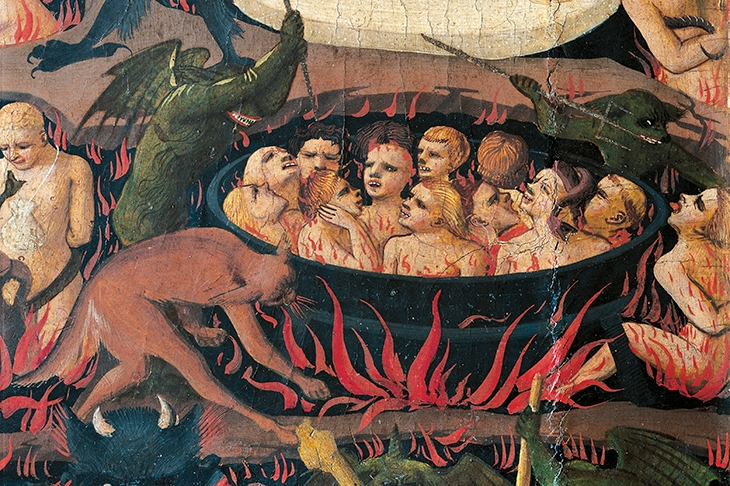
Hell of a Time

From 'To Hell with Hell', article in the
 Spectator by Peter Sanford 28/03/20

Joanna has been advised that ‘Hell’ is X-rated.  Apparently its not suitable for the family service.

Hell does present many conundrums.

Did God create Hell?  If the definition of Hell is ‘Where God is not’, then how could God create Hell?

Where is Hell?  We have enough problems envisioning space.  If God is beyond time and space, then where is the edge of space?  Can there be anywhere God is not?

John Powell in ‘Christian Vision: The True that sets us free (1989) quotes another priest by asserting that ‘God does not send people to hell.’ It’s a tricky one.  Why Hell?  What is the significance of Hell? 

Powell says that people choose their path, and Hell can be a choice, so his is not a universalist position. The parable of the wheat and the tares warns us that the decisions about who is ‘fruitful’, and who not, is not for us to make.  What a mercy.  But how do we understand ‘Hell’ in our modern secular society?

Let us consider the belief in the finality of live on earth.  Like the bird that fell down the chimney, that is ‘hell’, and then there is nothing, just as there was nothing before birth.

What if there is nothing when we die?  Then there is a choice to live for oneself and close family, or to do more for those around us, like caring for a community set adrift in the ocean.

But for those given the faith to see life as a journey, and to cling to ancient words of hope beyond the grave, then this life is not so significant.  Of course it is significant, but it’s significance is as the hors’ d’oeuvres as part of a banquet. 

Part of this is the idea that attendance at the banquet is a choice.  The banquet is not ‘organised religion’.  It is a marriage relationship with the creator.  It is life in the palace, and we are not alone.  There are people around us.  This is ‘the church’ (or what ever name you want to give it.)