Saturday, 9 October 2021

Strangeness

 Margaret bought me a small pack of Baci chocolates.  We shared them together.

Two of the quotes inside interested me.  They were:-

        "There is no beauty without a touch of strangeness."  by Edgar Allen Poe....and

        "Strangeness is a necessary ingredient in beauty." by Charles Baudelaire, Selected Writing on Art and Literature (written for the Paris Exhibition Universelle of 1855) 

Edgar Allen Poe
My Investigation
Main points-
Born in 1809 to English actors.  He may have been named after Edgar in King Lear.  His father abandoned the family; his mother died before he was three.  He was taken in by the Allen family.  
He attempted to live by writing.  He died aged 40 after a 11 year marriage to his cousin aged 13 at the time, when he was 27.  Was he marrying for a mother?  - His aunt became 'as a mother', his wife his sister.

My grandfather read 'The Pendulum and the Pit' to us when we where about 10 years old, and yes it terrified us, though when our grandfather fell asleep during the rendition this did help reduce sense of complete terror.

Allen Poe was one of the first writers to invent the 'detective novel', complete with difficult genius detective, innocent side kick, and cack-handed  police detective.  My grandfather went on to read us the Adventures of Sherlock Holmes.  Conan Doyle apparently said if all the writers who were profoundly influenced by Poe paid to give him a monument, he would have a pyramid.

Poe died under suspicious circumstances aged 40, found in the street in someone else's clothes. (Enough said.)  I enjoyed listening to The Forum on BBC World Service by the way.

If you search google for the origin of the quote found in Baci, you find only references to the quote found in Baci.  So there we have it-  What is strangeness?  What is beauty?  

Charles Baudelaire was born in 1821, 12 year younger than Poe, but he also died aged 46.  His father was 37 years older than his mother and died when Baudelaire was 6 years old. Baudelaire had an inadequate attachment to his mother, and was sent by his step-father to India, aged 20.  Here he was greatly influenced by the ocean, but not India.  He returned straight home, back to the taverns of Paris.

I read the following:- 

'In 1847, Baudelaire became acquainted with the works of Poe (Poe died in 1849), in which he found tales and poems that had, he claimed, long existed in his own brain but never taken shape. Baudelaire saw in Poe a precursor and tried to be his French contemporary counterpart. From this time until 1865, he was largely occupied with translating Poe's works; his translations were widely praised. Baudelaire was not the first French translator of Poe, but his "scrupulous translations" were considered among the best.'

Portrait of Baudelaire by
Emile Deroy, 1844
Quote taken with gratitude from 'Brainpickings' 

"Beauty always has an element of strangeness. I do not mean a deliberate cold form of strangeness, for in that case it would be a monstrous thing that had jumped the rails of life. But I do mean that it always contains a certain degree of strangeness, of simple, unintended, unconscious strangeness, and that this form of strangeness is what gives it the right to be called beauty. It is its hallmark, its special characteristic. Reverse the proposition and try to imagine a commonplace beauty! And how could this necessary, incompressible, infinitely varied strangeness, dependent upon environment, climate, habits, upon race, religion and the temperament of the artist, ever be controlled, amended, corrected by utopian rules, excogitated in some little temple or other of learning somewhere on the planet, without mortal danger to art itself? This element of strangeness which constitutes and defines individuality, without which there is no beauty, plays in art (and may the precision of this comparison excuse its triviality) the role of taste or flavouring in cookery; if the individual usefulness or the degree of nutritious value they contain be excepted, viands differ from each other only by the idea they reveal to the tongue."

Baudelaire's Grave in Montparnasse
Cemetery, Paris


Wednesday, 6 October 2021

On Suffering

 On Wednesday I attend a meeting for mental health social workers.  The speaker was Philip Archard, a colleague from CAMHS.  Philip wrote his PhD thesis on the study of social worker's attitudes and coping mechanisms when faced with the suffering they saw in lives of the parents and carers they worked with.  Philip's study demonstrated that although the social worker's in the main expressed left-wing views of the causality of suffering, the way they managed their own discomfort was to see the parents as somehow complicate with their own suffering.  Philip explained that by using a psychodynamic model of interpretation, it could be argued that this thought pattern protected the social workers from their own experience of trauma and helplessness.

It struck me that this was what was happening during the recent fuel crisis where government voices described the crisis as brought on by 'panic buying'.  They then spoke of mobilised the army, which of course was an action that was likely to counteract their calls for 'calm down'.  For most, being without a car is of little consequence, but for many it could be a matter of life and death.  Many disabled and elderly people are quietly served by an army of carers who use cars to reach them.  When petrol is not available for these people, panic is entirely appropriate.  

The task of social care and health is to reduce suffering.  We can define suffering as the psychic equivalent of pain.  


Reference

Iain Wilkinson (2005) Suffering: A Sociological Introduction


The beginning of Isaiah

 Isaiah – or ‘Jeshua Saves!’


1

Here is the record of visions received by Isaiah, son of Amoz, over a 100 year period.


Message to Rebellious Judah

The creator says


‘My children have risen up and oppose me!

Through rebellion they make themselves victims of retribution.

My beautiful people now stand abandoned, like a derelict building in a wasteland.


And what makes it worse?


They seem oblivious, still undertaking righteous rituals; all a waste.

They make their lives so difficult with privations and performances.

These mean nothing while they have the blood of the innocent on their hands.

Give up these evil ways! Sort out your oppressive practices.

Prioritise the poor and the vulnerable.

Simply repent and our relationship can be fully restored.

Ignore me now and you are walking into the swords of your enemies.’


2

The creator has spoken.


My people, once so faithful - now adulterous.

Once like pure silver, now like the slag sifted from the top,

Once the best of wines, now like extremely watered down plonk.

Your leaders are easily bribed. They do not defend the poor and vulnerable.


Enough of this!


A time of testing will come. The pure silver will be separated from the slag.


You will have wise and selfless leaders.

Those who turn from wickedness will be made strong.

A fire will rage that will burn up the things that have taken my place,

Things that are meaningless but receive much attention and wealth.


As the life of the world comes to an end, people from all nations will come to their creator.

The creator will be on the highest mountain, all people will acknowledge the creator and bring


perfect praise and honour. The mountain is called Zion.


The creator will mediate between the nations and help them to settle differences.


Peace, unknown before, will be declared.

Weapons of destruction will be converted to useful means.

The decedents of Judah will walk in the light of their creator.

All meaningless wealth, powerful weapons, scheming alliances,

All this will be brought low - nothing will stand.


Don’t put your confidence in human power; ultimately it’s as frail as breath.


3

How the mighty will fall.


Their sophisticated society will collapse into ruins.

Young children will take power, foolishness will reign.

And the creator will step forward and demand justice.

“How dare you allow my people to have their faces ground in the mud?”

Such beautiful people, now scabbed and wretched, barely alive.

But as the outward trapping are stripped away they find they are left with nothing,


Low and degraded.


4

All is not lost; a branch on the tree remains alive.

The creator lifts up the broken body.

The filth is washed away,

Wounds are healed with hot fiery breath.

Beauty comes back to Zion.

The creator provides shade on the mountain.


Cloud covers the mountain by day, and a fiery flame hovers by night.

We receive shelter from the midday heat, and a hiding place from the storms and rain.


5

I hear a song well up,


My beloved has a vineyard on a high fertile hill.

He ploughs the land and plants the vines. Every care is taken.

In the middle he builds a watchtower, he creates a winepress ready for the harvest.


The grapes grow well, but are they are wild grapes.


What else could I have done? I was expecting sweetness, but I receive a hash rebuke.


What shall I do? I will abandon the crop.

Uproot and tear down.


Wild animals shall make this place their home.


I planted expecting a crop of justice, instead I have found oppression.

I expected righteousness, instead I receive cries of violence.


See all this futility.

Many houses, but all empty,

Much wine, but all pathetically drunk.

So my people are taken away into exile.

The wise are ignored and go hungry,


All humanity is brought low, even the arrogant lower their eyes.


Wild animals will prosper in the ruins,

The wicked will mock the creator saying;

“Hurry up and sort out this mess.”

But the creator’s anger is burning,

For the futility of his people, for their destruction.


The creator sends a signal to nations far away, a whistle to the ends of the earth.

People are coming, purposefully, without tiredness, surefooted, like an arrow,


Sparks flying from their horses hooves.

A lion is roaring, like the roar of the sea.


So far there is only darkness over the land- the light is withheld.


6

It was in the year that King Uzziah died that I saw the creator,

Seated on a high throne, with billowing robes filling the chamber.

In attendance were mighty and strange figures; people with six wings.

Two wings covered their face, two their feet, and they flew with the third.

Together they sung an awesome song of praise to the creator.


“Great, Mighty, Perfect is the creator,

Every part of the earth is filled with this glory.”


As they spoke, the building shook terribly and from its foundations smoke rose up.


I cried out


“my life is over, I have seen perfection, and I am wretched and contaminated.

I am from a people who do wrong. Surely I cannot see the creator and live?”

Then one of the strange beasts flew to the centre of the room to a great fire of burning coals.


The beast took tongs and picked up a coal,

Coming over to me and gently touched the coal to my lips.


I then hear say:


“See this coal; it has touched your lips. Now your imperfections are removed.


You are made clean as new.”

The creator surveyed the whole world and asked,

“Who can I send as a messenger to these people in their need?”


And I stood up and said

“Here I am, Send me.”

And the creator replied,


“yes, you go, but be aware, these people will hear, but they will not understand.


They will watch, but learn nothing.


They will see with their eyes, but turn away from healing.”

Continue until all their towns are empty, their houses deserted.


The land turned to waste.


But a remnant will endure, a stump, a terebinth.

This is the hope that remains.”


7

King Uzziah’s grandson, Ahaz, came to power.


And it was discovered that Syria and Israel planned to gang up on Judah and lay it low.


Everyone in Judah was quaking.

Then the creator spoke to Isaiah and said

“Take your son ‘Remnant Returns’ and go to Ahaz.

Tell him to stop worrying. Nothing bad can happen to Judah.


Syria is held by Damascus, and Damascus by its king. And the King will come to nothing.

Same goes for Israel. Samaria and the King are finished. Trust in me and be safe.”

As time passed the creator sent Isaiah again, to strengthen the king’s faith.

“Ask for a sign and it will give to you. Make it tough.”


But Ahaz said


“I’m not doing that. Playing around, that’s not my style.”


Isaiah was exasperated.

“Look, this isn’t just about you. It’s about the line of King David. There will be a sign - an impossibly

difficult sign also. A child will be born to a virgin mother. He will have the name ‘Restored Once

More’. He will understand justice from weaning. Before he grows up the threats you fear will be

gone. Until then your family will be safe. After that, the Assyrians and Egyptians will swarm over


your land. They will come with a razor and scalp the hillsides.

This is a hard message, and one to be respected.”


8

Next I was instructed to make a sign with bold words saying


‘Stolen and carted away.”

I had good people watch me do this.


My wife gave birth to our second child and we were instructed to name him


‘Stolen and carted away’.


When he utters his first words will be the day of the Assyrian attack.

And just as the warning states, they will be exiled.


Then the creator explained.


“I care so much for these people but they do not listen.


They were so exultant at the down fall of Israel and Syria that they forget their own predicament.

The swollen river of the Euphrates has come from Assyrian and washed them away.”


And the creator who helps me to be strong says:

“Don’t think like these others. Fear only me and you will be safe.

The one ‘Restored once more’, will be a great rock.

Sadly for many, they will trip and fall.


Put your trust in me, even though it looks like I have turned away from my people.


Some will look to other evil and devious powers for help.

They will deny the creator and stumble on in darkness.”


9

This darkness cannot go on for ever. My people will be humbled.

A time is coming when, in Galilee, where foreigners live, that my glory will be seen.


And people who have lived in darkness will see a great light.

My people will be joined by many, and there will be great rejoicing.

They will be released from servitude, and their heavy burdens will be lifted.

The oppressor’s power will be broken; the weapons of war will be burnt.


And the restorer will be called:


WONDERFUL COUNSELLOR, MIGHTY CREATOR, EVERLASTING FATHER, PRINCE OF PEACE.


And his rule will go on for ever and never end.

This is the creator’s will and it will happen.


People, dearly loved, who turn away from this life force will surely suffer.

They attempt to create a city in their own strength.

But this will not protect them from their enemies.

Even after great suffering they do not turn.

It is a terrible outcome.


10

The untouchable, corrupt Judge will fall.

Assyria, in its haughty power will fall.


In their arrogance they do not realise that their actions are part of a divine plan.

How can the adze boast greater power than the one wielding it?


Fire and pestilence are my weapon.

I leave only a few children.


But the remnant of my people will stop trusting in human powers.


They have been sifted, and now will return.

As the enemy rests at Nob, it shakes its fist at Mount Zion.

Look, an axe is falling; the mighty tree of Lebanon has been struck.


11

Out of the stump of David’s family will grow a branch.

It will bear fruit from the ancient root.

And the spirit of wisdom, of the creator, will rest on him.

His complete inclination will be to live in step with his creator.

The poor and the destitute will receive justice.

The whole earth will shake at the force of his words.


He will wear garments of praise; righteousness his belt, truth his undergarment.


We will see the wolf and the lamb lie down together.


The calf walking with the lion.


Babies will play near the cobra’s hole; they will pick up snakes and not be hurt.

A banner of salvation will declare that David’s heir in on the throne.


All nations will rally to him.

Israel and Judah will be reconciled.

On that day the creator will bring back the remnant,


From Iraq, Egypt, Ethiopia,

The creator will devise the routes back to Zion.


Rivers will be d

Tuesday, 28 September 2021

Compare and Contrast

 On Saturday evening, driving home from London, I listened to the moving account of  the children of Nuremberg defendants talking about the legacy in their lives of that famous trial.  The following day I listened to a radio play entitled Dante's Inferno.  It struck me straightaway that here was connecting theory with 20th century practice.

Inferno I begins....

"When half way through the journey of our life

  • I found that I was in a gloomy wood,
  • because the path which led aright was lost."
Inferno III

  • "These wretched souls, who never were alive,
  • were naked, and were sorely spurred to action
  • by means of wasps and hornets that were there.
  • The latter streaked their faces with their blood,
  • which, after it had mingled with their tears,
  • was at their feet sucked up by loathsome worms."
  • I recall the picture painted on the walls of St Thomas church in Salisbury.  Hideous pictures of hell.  And surely we all, as Terence the Roman Playwright comments, 
  •  "I am a man; I count nothing human foreign to me"  
  • It's a terrible thought that we are made of the same fallible material.    

  • Hell Incarnate- St Thomas Church- Salisbury


    Next I recall a discussion on the poetry of Gerald Manley Hopkins, writing about what we now call depression, what his friend Robert Bridges noted as 'The terrible Poems'.  They were far from terrible, but his friend described them as 'awful', 'terrible', 'fearful'. 
  • "O the mind, mind has mountains; cliffs of fall 
  • Frightful, sheer, no-man-fathomed. 
  • Hold them cheap 
  • May who ne'er hung there. 
  • Nor does long our small 
  • Durance deal with that steep or deep. 
  • Here! creep, 
  • Wretch, under a comfort serves in a whirlwind: all 
  • Life death does end and each day dies with sleep." 
  • Gerard Manley Hopkins  (With thanks also to 'In Our Time'.)

Saturday, 11 September 2021

The Spinning Lime Tree Seed


Hubschraubermuseum Bückeburg
Leonardo de Vinci's Manuel Helicopter
De Vinci worked as a military engineer for the Duke of Milan between 1487 and 1490.  In this time, 450 years before anything actually rose from the ground carrying humans, me made the sketch that the above model replicates, and is to be found in the Helicopter Museum in Buckeburg, Germany.  

Toy bamboo rotors have been found in China dating back to 300BC.  

Modern Japanese flying toys

As I gaze out on my street, the wind blows between the avenue of lime trees, and the seed cases take off, like a science fiction invasion of alien craft.  The seeds are set off a central stem to create a flywheel effect, carrying the rotating kinetic energy into the curved leaf fins.  The seed shoot upwards high above the parent tree.  


The real step forward in flight came when it was realised that the cross-section of the wing must be an aerofoil, not a thin piece of cloth as illustrated by de Vinci.  Flight is all about creating a vacuum above the wing.  The spinning lime tree seed forces air downward.  The weight of the seeds themselves maintain the vertical stability by rotating like a steam engine's 'governor'.

.  

I have always wondered why Leonardo's design has become so famous.  The most well known of these pictures is to be found in Paris, having been taken there by Napoleon.  I assume the fame is not so much the design, which anyone can see does not have the second screw necessary to stabilise the body of the plane.  Also these principles can easily be observed in nature.  But it is the audacity to also place humans on the machine.  It is not a surprise that the pictures remained in de Vinci's sketchbook.  They were for a different generation.


Wednesday, 8 September 2021

The World's War

David Olusoga is a professor of Public History at Manchester University.  He is of Nigerian and white English parentage.  His studied of the contribution of  non-European combatants in the first world war and wrote the book 'The World's War.

 These are the things I noted in particular.

1) German Fountain.  

The German Fountain
Built in Germany and transported to Istanbul as a gift from the German Kaiser Wilhelm II to the Sultan Abdulhamid II to commemorate his visit to the Ottoman Empire two years before. 

2) Panthéon de la Guerre


A 123 meter circular painting painted by  Pierre Carrier-Belleuse and Auguste François-Marie Gorguet during the fighting.  Olusoga noted that the painting was a picture also of what happened after the war.  The painting began as a very inclusive representation with honour even given to the Chinese Labour Corp.  As the war ended there was pressure to paint over the 'foreigners' to make room for the white Americans who had joined the war near the end. An American Businessman bought the painting in 1927, and displayed in Madison Gardens where it was very popular.  After the second world was it was no longer of interest and it was chopped up.  Only 7% was retained focusing on the Americans and is now displayed in Kansas City museum to the First World War. 

3) The Hamburg war memorial to the War in German East Africa.

A controversial memorial in a Park in Hamburg to the many African who died in the German East African Campaign.  It was restored and augmented by Nazi Germany.   


4)  Wünsdorf - A place in Eastern Germany with an extraordinary history. The Halbmondlager or Half Moon Camp, near Wünsdorf , 25 km from Berlin, was where non-white POWs were brought by the Germans during WWI where they were well looked after in the hope that they could be wooed into turning on their colonial masters.  The aspect of religion was also built up to given them the impression that German was very supportive of their rights to independence.  For Muslims they encouraged 'Holy War', a spirit that had already been evoked by the Ottoman Sultan.  

Lenin now stands alone. 
Wunsdorf became the centre of the Russian
occupation of East Germany


The first mosque in Germany-
Built of wood. 
In a POW Camp

5) The Chinese Labourer's graveyard.  ever thought about the extraordinary amount of work that went into constructing 400 miles of complex trenches?  A lot of the work was done by 100,000 Chinese indentured labourers who signed up to dig trenches and later in the war, service the tanks.  
These are the people who were truly forgotten after the war.  The CWC is trying to make up for it.  Long into 1919 the Chinese labourers were toiling on repairing the damage to the country side from the war, and collecting live ammunition and dead bodies from the battlefield.
Noyelle Sur mer Chinese Cemetery


Friday, 3 September 2021

What the Devil?!

The Kibworth Windmill

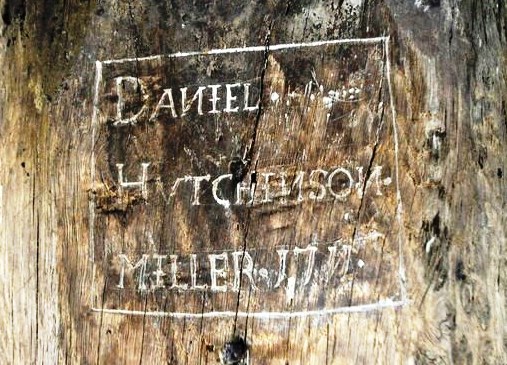
'Archaeologist James Wright said: "These marks are significant as they show real belief in Satan and demons lasted much later than is sometimes thought."   This comes from a story reported on the BBC website about the examination of carvings on a Leicestershire windmill dating back to 1711.  

Daniel Hutchinson 1711

"So people do not believe in Satan now?"  I ask.  "What do I make of the concept of Satan?"  I have recently read the ancient story of Job from the Jewish mystical books.  This is a story that debates the nature of good and evil.  Satan is described as a being who comes into the heavenly courts and persuades God to allow him to put Job, a good man,  to the test.  The test is whether Job will reject and curse God when things do not go his way.   Famously things get about as bad as they possibly can.   Ultimately Satan is not successful, but Job does feel completely abandoned and 'put out to dry' by God.  I'm interested why Job chooses to target God not Satan.  It is very clear in the story that Satan's authority comes ultimately from God.  God allows Job to suffer.  It is not God's choose, but ultimately everything happens with the authority of God.  Just as Pontius Pilate allowed Jesus to be executed against his better judgement, so Satan brings suffering to Job because he is allowed to do so.

Job's is angry with God because he can not understand why he suffers so.  Job asks the question that is often asked, 'does the creator attend to me as an individual, or is this all a mind game?  This is question raised in the story 'Touching the void', when in 1985, Joe Simpson calls out to God in his moment of need...and hears nothing.  Again it is the subject of Feuerbach's book 'The Essence of Christianity' .  Indeed, I had this discussion yesterday with my Muslim neighbours.  The Muslim idea is that we pray to God because it is good for us to do so, not that there is any connection with a supreme being.  It is ridiculous and egocentric to imagine this possible.

But if you are patient and continue reading Job to the end, God does appear and is clear about what's going on.  Or is he?  The message I read is that 'that things happen' and there is no questioning why.  They just happen, we are required to accept this.  Suffering in this context is not intended as a punishment.  But just as bad things happen, so do good things.   Ultimately Job's fortunes change.  The message is that it is personal.  We are not overlooked.  We are loved.  

So what about evil?  Evil forces, spirits, ideology moods?  Are they personal, or are they like Tsunamis, or avalanches, that just appear and will sweep aside all in their way? 

Evil is like treading in dog muck.  Not very nice.  It stinks.  So best we avoid becoming too familiar with it.