Friday, 20 April 2012

A Quirky Tour of Leicester

Come with me on a journey


The quirky tour of Leicester is best undertaken by bicycle
whilst wearing a top hat.


1) Start on Victoria Park at a fine piece of brutalist architecture; James Stirling's 1959 Leicester University Engineering Department.  It's probably the only building from Leicester that can be found in international studies of modern architecture.  It's my favourite building too and a good starting point for our tour.


2) Stop off at the Lutyen's War Memorial to the great war, build in 1923.  It is very similar in style to other other great arches he designed, for example, Thiepval.  Not beautiful, but neither is war.  
Leicester
Thiepal


3) Follow Peace Avenue down to University Road, past memorials to the women who died in the war, and commonwealth soldiers.  On Lancaster Road, stop off at the Richard Attenborough Centre for disabilities and the Arts.  This houses an excellent cafe, and some of Richard Attenborough's fine Picasso ceramics.  Follow the cycle route across Waterloo Way.  Notice the modern blue and beige building on the right.  It is another Leicester award winner.  This time architecture's carbuncle prise 2008.  Continue around the edge of the Prison, and up Infirmary Road to the Magazine (the gateway, not the pub.)  Notice the Jain Temple, with it's fine marble facade.  It was a congregational church once.  If you go round the back, you can see on the roof, an amazing array of gompahs.  

4) The Magazine; a bit of old Leicester stranded in the new.  This sums Leicester up.  Notice the bright copper green of the new DeMontfort Business building opposite the Newark House museum.   Near by is the old city wall, the Castle Mote, and St Mary De Castro (Leicester has a long history of communist sympathies.)
The magazine


5) Walk through Castle Gardens to see the Castle Mote.  See the submerged route of the old city wall, tastefully picked out in white marble chippings.  At the end of the garden near to the busy main road into the city centre is a memorial to Richard III.  It is said that his dead body was brought in to Leicester from Bosworth field on the back of a horse.  (He had just lost his kingdom.)  It was laid to rest in the crypt of the Greyfriars.  Funnily enough, that place went on to become the main offices for Social Services, and I can vouch that there is still a strange smell in the basement, where the records are kept.  It is also said that his body was later taken from the crypt, and thrown into the river soar, near to the statue.

Jewry Wall
6) I like the Jewry Wall and it's Museum.  It is usually very quiet.  The roman remains, as noted by Pevsner, have that  'heavily restored' look to them, which makes you wonder whether they are genuine at all.  Mind you, this work was done in the 50's, so they are become ancient relics in their own right.  The Roman wall is fantastic, and it is a complete mystery why it has been left untouched for 1900 years.  

7) If you are feeling cold, do look in at 'Britain's Heritage' fireplace centre.  It's on a street called Holy Bones, next to the Guru Nanak Gudwara (which also has a free museum.)  Next to this building are the offices of the Mablethope Children's Holiday Centre, where many of Leicester children go for free holidays to the seaside near Skegness.  Also near this building is an awesome underpass, worthy of Croydon.  A colleague of mine who grew up in Leicester told me that when that was built, the residents of Leicester knew for certain that they lived in a truly great city.

Wyggeston House
8)  Cross over the top of the underpass towards the city centre.  Apparently this recently appointed municipal car park will soon be dug up again, and turned into a tranquil square, to commemorate the Queen's diamond Jubilee.  The far end of the street is bordered by High Cross.  This street was once the main thoroughfare through Leicester.  Not so now, like an ox-bow lake, separated from the main flow. It is difficult to see Wyggeston House, left slumped to the right of the square, but it's worth a glimpse.  Next to it is the Guildhall and the Cathedral.  From here the new Shopping Centre, with it's gigantic Christmas aluminium covered turkey, lies between you and another oasis of green and history.  The Unitarian Meeting Hall is a fine old building.  The monuments to the great and good read like a Leicester street directory.


The county Rooms
9)  Cross over the road from the Cathedral grave yard to a back street I enjoy called New Street.  This street has a number of lawyers offices and is unassuming and old.  At Friar Lane turn right, past Greyfriars.  At Hotel Street, you can see the County Rooms.  These fine Georgian Assembly rooms haven't changed much, and still act as a focal point for high class fun.  Just outside, as if to note that some people have always slaved in this city, is the seamstress, and rather fine sculpture.  You can visit Leicester Market from here.

10) Leicester Market.  At about 11.00 am on a Saturday morning, you will see something on the market that is typical of Leicester. It is a genuine piece of the world, that you may have to spent £100's to see otherwise, here on our doorstep.  Chinese traders have set up an enterprising array of stalls, largely selling hot food to the Chinese students from the two universities.  There is not much written English here, so take pot luck, just like my aunt used to have to do when she took us out in Hong Kong as kids.

Leicester Town Hall (a city, since 1921)
11) Visit the Town Hall Square.  Leicester Town Hall is a find Victorian 1878 building built in a Flemish style, rather than Gothic, which I find refreshing.  See also the Methodist Church on the square, associated with John Wesley.  Left down Bishops Street, notice the fine, but now empty, Midlands bank building, with it's enormous art nouveau stain glass window.  Also the Turkey cafe, built in 1901.

12) Continue down Rutland Street to find the new 'Curve' (in Leicester we tend to drop the 'the', calling it simply 'Curve', as in "I'm just going toilet".)  'Curve', built in 2008, designed by Rafael Viñoly , may also join the international architecture books, but I not so sure.  It looks a bit like a cross between the Titanic and a radiator.
Turkey cafe

'Curve'
13)  Cut through St Stephen (Serbian Orthodox) church yard to The Leicester Mercury Building (Terminus for the Titanic?)  You are heading for London Road and back to Victoria Park. Two buildings to note.  One the Railway station.  What a great building.  Two, the Top Hat Terrace half way up the hill on the right, look round and up, and see the teardrop window.  Then down DeMontfort street to another St Stephen's church (Scottish Presbyterian).  Amazingly, this building was moved, stone by stone, from it's original site next to the train station.   

14)   Let's end at the New Walk Museum.


Have a rest on your route


Friday, 13 April 2012

On Power

We went to Stratford on Wednesday and saw the Tempest. Here are some of my thoughts arising from the play.


In The Tempest
Current day example
The Coup
Prospero is ‘over-throne’ by his brother. 


Any British general election; one set of megalomaniacs is replaced by another.
The Island Domain
Prospero is Lord over his rock in the ocean.

Any child who stamps on ants.
Falling in Love
Ferdinand becomes a slave to Prospero for the love of Miranda.  Miranda learns that she holds power over Ferdinand, but it is equal to the powerlessness she also feels.

Equality of true love; all powerful, but yet completely helpless.  The state of interdependent love.
Misplaced devotion
Calaban places his trust in Stephano, the king’s drunken butler.

Anyone who voted for the Liberal Democrats at the last election will know this feeling.
Power of influence
Prospero relinquishes absolute power, for power based on trust and influence.  We see his anxiety as he throws away his prop.

Good parents hold power over their children through little more than influence.

Monday, 9 April 2012

Thoughts of life without cancer

What happens to Theo's blog now that Hogkin and been smogkined?

In the west we divide into those who know they have cancer, and those who do not know.
In the east, many take one day at a time, and assume that it may be their last.
If they die, no one asks how they died, they just grieve.

Margaret's Aunt Elizabeth knows she has cancer, but doesn't know it's will.
A sore throat or sharp pain may be something; it may be nothing.

Today- I hear my neighbour working hard;  light, rhythmic sawing.
I imagine that he is constructing his wife's new pottery, which he is fitting in their cellar.

I feel the cold air coming from the kitchen window.   The sensation is tingling down my back.  I decide not to resist this, as it speaks of a damp Easter Monday.  Which is what it is.

Today, what is to be done?  I want my factious and exhausted family to enjoy being together, and simply be together.  Surely this is a challenging desire.

Striving to achieve this, can easily bring disappointment.
As with reaching out to catch a butterfly.
Straining, and grasping, I find it crushed it in my hand.
But with this moment of calm, I find that it comes closer; it may even land.

We are not alone.  The only way to know this it to experience it, to feel it, to put your hands in it.
Sometimes we can hold on to hope for long periods of time.  It grows more faint; less secure.

But hope is not based on this experience.  Experience is an aid to hope.
My hope is in the security of relationships.  As with all relationships, the core is desire.

When I die, I do not want them to lie, to use rosy words, or anything that would cause me to blush and squirm.  I want them to speak of desire.

Sunday, 8 April 2012

Three Statelys in a Week

View over Rydal Water

The preamble is a trip from Rydal, up Herons Pike (lunch), with a view over Grasmere, along the ridge to Great Rigg, and down (thighs still sore) to Grasmere.


Grasmere is famous for Andrew and Margaret visiting the gingerbread shop and buying and embarasingly large amount for consumption in a local cafe...where we also viewed this fine pair of Goosanders.

Stately One;  Holker Hall.  Like the queen, some aristocrats have numerous houses and too much stuff to fill them with.  In 1872, when a wing of Lord Cavendish's mansion burnt down, he rebuilt in on a grand scale.
His dad at Chatsworth had some spare junk to put in it, and the place was ready for royal visits. 
After the revolution ....(shut up Andrew.)


Here is a picture of Elizabeth shinning up a tree.

Sately Two; Levens Hall.  Not far from Elizabeth Bennett's minor stately, is this ancient topiary hot spot.


Unfortunately Elizabeth got her head stuck...

Spring flower (before winter set in the following day) were in abundance.  
Snakes Head Fritilery

Auntie Elizabeth wasn't feeling too great which was sad, but she was able to make a trip to the sea.

Stately Three; Buscot House.


Superboy saves the day- with a little help from his friends.


We celebrated Frances birthday on the 6th April in Wantage.  Here we found an egg growing Tree, or is it a tree growing eggs?  On Saturday we visited Buscot House, freshly cleaned for the new season.  

Burn-Jones- Sleeping Beauty

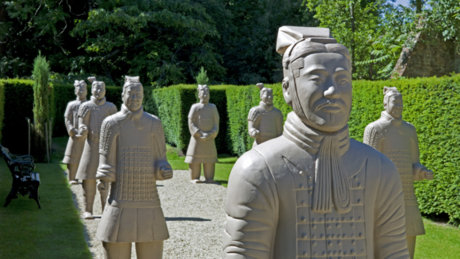
On tour from Xian

Lord Faringdon descending the steps of Buscot House - Sickert

Friday, 30 March 2012

Missing Pamela

This is the story of Pamela Green,
Who's known to me as as the poetry Queen.

From Cambridge she graduated, achieving a first...
in 'weekend socialising', joint with unsated academic thirst.

To the state she became a 'servant', a most unsuitable term,
"Be a sweetie and pass my bag", said she, with not a hint of a squirm.

Pamela was a great collector of numerous things,
Postcards, books, shoes and anything that rings.


Erno's Alexander Flemming building provided wonderful sights,
Of pigeon eggs hatching, though might they also carry mites?


What's the difference between GP fund holding and the IRA?
The IRA are said to have sympathisers.   - Old DHSS joke from yesteryear

To Ilkley Pam travelled, as the department relocates,
To a house full of stairs at Ashburn Place.

'Twas on the day of her arrival, for those who take notice,
That Betty's the tea shop started a home delivery service.


Pamela lived ten years longer than was predicted her fate
But sadly slowed to a halt with that ridiculous gait!

Pamela we miss you-  Andrew Starr

Sunday, 25 March 2012

A Walk Through Peatling Magna (nothing to do with pets.)

Aberdeen was the warmest place in the UK today.  It was also summer in South Leicestershire as I set out for a Sunday afternoon stroll.

Path to Peatling Magna church


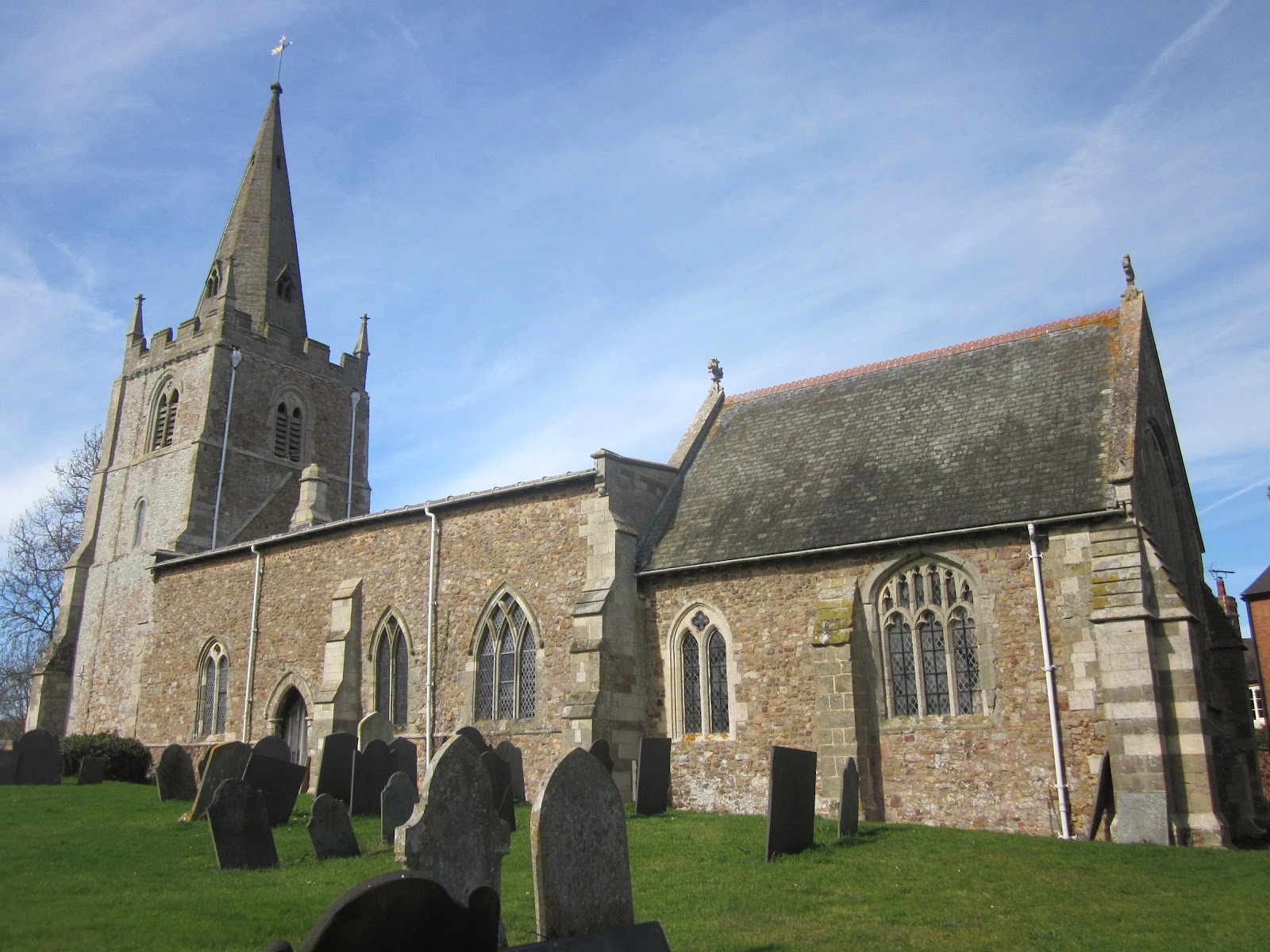
Peatling Magna deserves a visit if for it's name alone, but there is plenty to see on an early spring day.  The green path to the parish church, unaccessable by car, reveals few travel that way.  I enjoy the discordance across the churches roof line.  If it was the priest who owned the house next door, it was clear who could afford the better roof.   Even his garden seemed to be laughing (it had a haha.)

I'm heading out across the old vicarage garden towards Arnesby on the neighbouring ridge.  The current owners  have recently added a lake to their property, which is not featured on my map, but they have kindly allow the footpath to retain some dry land. The next few fields are full of sheep about to lamb.  A few lambs have already made it and must have been born today.  I cross the stream on an incongruous bridge, and see tiny fish darting away from my shadow.

The farmer has put up signs indicating that the footpath was moved on the 12th of January.  I scan the field for indications of the new direction, but only the old path is visible.  The change seems to me to be of no consequence to the route, and I wonder why he has bothered.  The route now ascends up into the village of Arnesby.
Arnesby Church

At the top of the village is the windmill.  I muse that the property is owned by a racing enthusiast or even a retired racing driver.  There is a racing car wind vane, and lots of smart garages.  One has a large clock, showing the correct time (The clocks went forward today.)  This owner knows about time; clearly a racing driver.

Arnesby Windmill
The route back crosses furrowed fields.  The drainage is badly needed.  The ditches are full of reeds.

Reeds growing in the furrows
Three buzzards wheel over head.  They never come close enough for a picture.  They call to each other, and make wonderful silhouettes against the sky.  The path returns to Peatling.

Back in Peatling Magna, I just have time to do a 'figure of eight', so I continue through the village and head along a track called Mere Road.  It's mud and furrows; perhaps once a contender for a main road, but didn't made the grade and returned to ruts.  Along the verge the violets provide bursts of bright colour.

The path returns to Peatling following the Leicestershire round.  The hedges are blackthorn.  Their tort buds ready to explode into bloom, like pop corn shaking and fizzing in a pan.
Violets

Popcorn

White Violets


Comfrey


Back at my car I leave smartly, leaving my village fantasies behind, and return to my urban life.  I weave through the outer suburbs of Leicester, pleased with my knowledge of the Leicester back streets, returning to tea and cake with Margaret.

Sunday, 12 February 2012

RSPCA

I am sure that there is a moment in children's lives when they seriously wonder whether babies were swapped in the maternity ward.  Today Elizabeth learnt that she has a two week work experience placement with the RSPCA.  This is a dream come true.  At last she (and no doubt Joanna to follow) will be able to mix with sensible people who understand that the planet was created for more than bipeds.